Notice. New forum software under development. It's going to miss a few functions and look a bit ugly for a while, but I'm working on it full time now as the old forum was too unstable. Couple days, all good. If you notice any issues, please contact me.
PhenixRising Guru Joined: 07/11/2023 Location: United KingdomPosts: 2098
Posted: 10:04am 23 May 2026
Copy link to clipboard
Print this post
Hi Lyle,
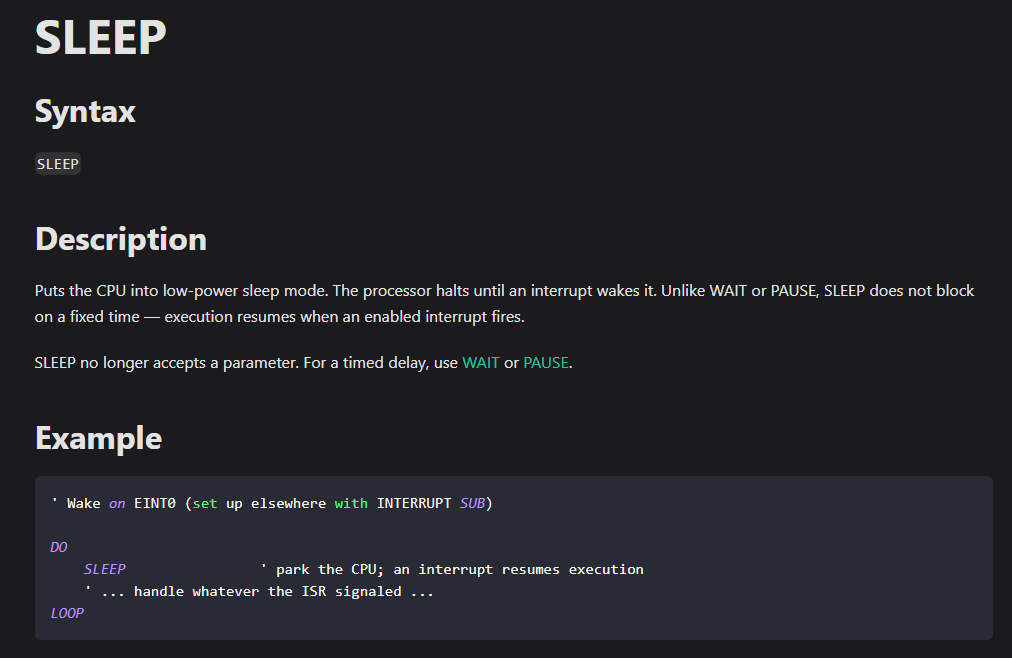
Yes the SLEEP is what caught my eye because others have mentioned it.
It's so nice to settle on the RP2350 DIL module, running MMBasic and having another, running ARMbasic as a super high-speed peripheral.
I'm currently testing and not surprisingly, it's FAST
PhenixRising Guru Joined: 07/11/2023 Location: United KingdomPosts: 2098
Posted: 11:55am 23 May 2026
Copy link to clipboard
Print this post
The label "main:" wasn't mentioned in the documentation and if you don't have it, the compiler gets all upset.
zeitfest Guru Joined: 31/07/2019 Location: AustraliaPosts: 702
Posted: 02:54am 24 May 2026
Copy link to clipboard
Print this post
AFAIK the pico does not use a dedicated arithmetic unit like other processors, but instead uses optimised software routines. So the interpreter and compiled version probably execute the same underlying stuff, as opposed to a compiler's code accessing a arithmetic/logic unit. The times are slow compared to a more usual processor. Even crappy laptops are pushing teraflops now.
Mixtel90 Guru Joined: 05/10/2019 Location: United KingdomPosts: 9220
Posted: 07:02am 24 May 2026
Copy link to clipboard
Print this post
It sort of has... From the Datasheet:
Note that there is no speed gain from using integers in BASIC or from a compiler optimising code as integers or single precision. However, where some hardware coprocessors fall back into software mode for double precision the M3 doesn't. These coprocessors are *very* fast as they are not complex structures.
It's pretty impressive really. Section 3.6.2 of the RP2350 Datasheet.Mick
PhenixRising Guru Joined: 07/11/2023 Location: United KingdomPosts: 2098
Posted: 10:16am 24 May 2026
Copy link to clipboard
Print this post
But they don't run @150Mhz
PhenixRising Guru Joined: 07/11/2023 Location: United KingdomPosts: 2098
Posted: 10:18am 24 May 2026
Copy link to clipboard
Print this post
No kidding. I remember thinking that I could speed something up by going all integer but the difference was negligible.
zeitfest Guru Joined: 31/07/2019 Location: AustraliaPosts: 702
Posted: 10:29am 24 May 2026
Copy link to clipboard
Print this post
They seem to be describing something that is a few thousand gates used as an accelerator for software doing math, as a math coprocessor. Usually a math coprocessor is something that does math ops in a few instruction cycles and is much faster. (ed) I gather the pico 2 does do some math ops in a few cycles but the speeds above are still slow. Edited 2026-05-24 21:00 by zeitfest
PhenixRising Guru Joined: 07/11/2023 Location: United KingdomPosts: 2098
Posted: 11:07am 24 May 2026
Copy link to clipboard
Print this post
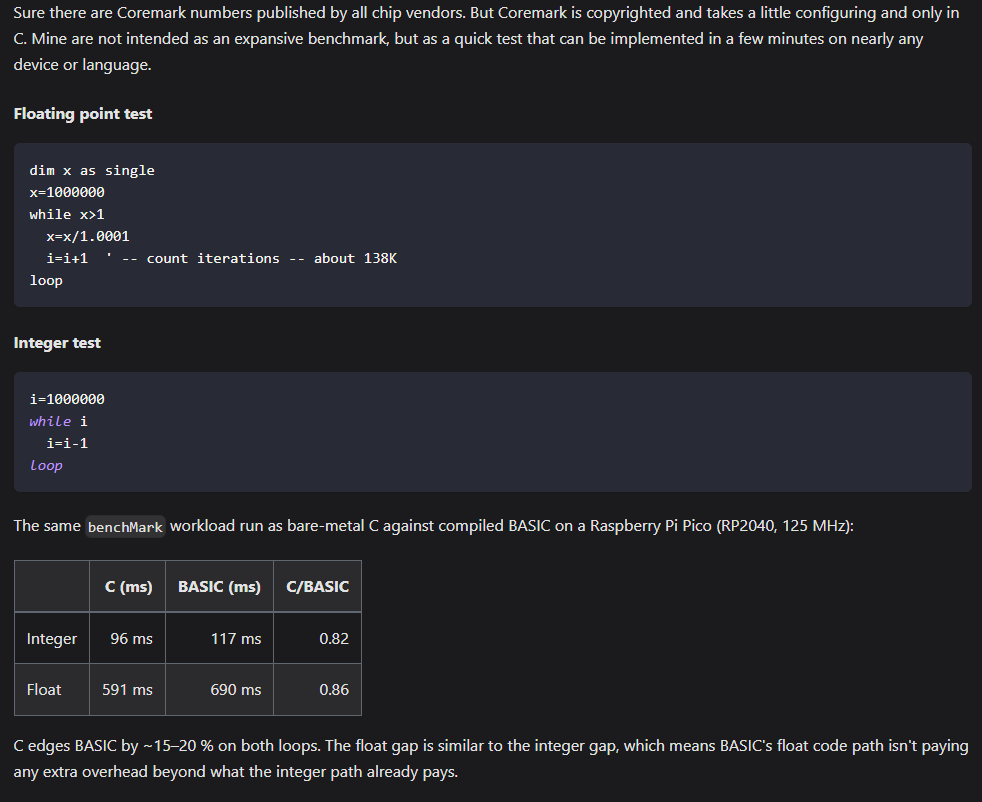
The benchmarks on our table are per iteration (time taken/1000)
The benchmarks above are for the FULL 1000 iterations (stated at the top).
Mixtel90 Guru Joined: 05/10/2019 Location: United KingdomPosts: 9220
Posted: 03:13pm 24 May 2026
Copy link to clipboard
Print this post
I think they referred to it as a "coprocessor" as that's what it sort of does. They also refer to it as an "accelerator", which is probably a more accurate description.
Oh, the evils that are benchmarks! a) make sure that the compiler for your chosen hardware is optimised to the hilt for it. b) use a general purpose compiler for your competition's hardware, preferably a non-optimising one that generates lots of labels. c) bask in the glory that comes from one-upmanship!
If you hand the accelerator a single command it will probably be faster than any true "math coprocessor" at the same CPU clock speed. Anything more complex and it will get increasingly slower, but by how much may not always be relevant.Mick
zeitfest Guru Joined: 31/07/2019 Location: AustraliaPosts: 702
Posted: 07:47am 26 May 2026
Copy link to clipboard
Print this post
I had a squiz at the datasheet
Apparently the ARM processor uses a FPU for single-precision. Double precision math uses the accelerator which splits it into chunks and feeds the chunks back to the main processor to be digested using the single precision FPU. Clever enough I guess but kind of mediocre IMHO.
Mixtel90 Guru Joined: 05/10/2019 Location: United KingdomPosts: 9220
Posted: 09:48am 26 May 2026
Copy link to clipboard
Print this post
A fraction of the complexity, size and cost of a a full double precision FPU though. The ARM Cortex series cores are optimised for low cost and high efficiency, not highest performance. There have to be trade-offs. A big FPU sits there doing nothing for most of the time in many cases.Mick

 Notice. New forum software under development. It's going to miss a few functions and look a bit ugly for a while, but I'm working on it full time now as the old forum was too unstable. Couple days, all good. If you notice any issues, please contact me.

 Print this post